How I Mastered Balance Training to Speed Up My Recovery—And Why It Changed Everything
You don’t realize how fragile your body feels until you’re recovering from injury or intense physical strain. I was stuck—aching, unsteady, and frustrated—until I discovered the real power of balance training. It wasn’t just about standing on one leg; it became the missing link in my recovery. Backed by science and tested through real experience, integrating balance work didn’t just help me heal—it rebuilt my confidence in movement. This is how it can do the same for you.
The Hidden Struggle of Physical Recovery
Recovery from injury or prolonged physical stress often feels like an invisible battle. While pain may fade, many people continue to experience subtle but persistent challenges: a wobble when stepping off a curb, hesitation when reaching for something on a high shelf, or discomfort during simple household tasks. These are not just signs of lingering weakness—they reflect deeper disruptions in the body’s ability to coordinate movement and maintain stability. The frustration many feel during recovery stems not only from physical limitations but from the loss of trust in their own bodies. Movements once taken for granted now require caution, and fear of re-injury can quietly erode confidence.
Traditional rehabilitation approaches often focus on restoring strength, flexibility, and range of motion—important goals, to be sure. However, they frequently overlook a crucial aspect of healing: neuromuscular re-education. This refers to the process by which the nervous system relearns how to communicate effectively with muscles to produce smooth, controlled movements. After an injury, the brain may develop new movement patterns to compensate for pain or instability. While these adaptations offer short-term relief, they can lead to long-term imbalances, placing extra strain on joints and soft tissues. Over time, this increases the risk of secondary injuries and delays full functional recovery.
Balance training addresses this gap by retraining the body’s sensorimotor system—the network responsible for detecting position, motion, and force. It helps restore the connection between mind and muscle, ensuring that movement is not only strong but also precise and coordinated. Unlike isolated strength exercises, balance work engages multiple systems simultaneously: the inner ear (vestibular system), joint receptors (proprioception), and core stabilizing muscles. By integrating these components, balance training supports a more complete and sustainable recovery. Yet, despite its proven benefits, it remains underutilized in many standard rehabilitation programs, often treated as an optional add-on rather than a foundational practice.
What Exactly Is Balance Training?
At its core, balance training is any activity designed to improve the body’s ability to maintain control of its position, whether stationary or in motion. While popular fitness trends may showcase dramatic poses on unstable surfaces, true balance training goes far beyond aesthetics. It is a scientifically grounded method of enhancing the body’s internal feedback systems, enabling safer, more efficient movement in everyday life. The goal is not to impress others with difficult stunts, but to build a reliable foundation for mobility, coordination, and joint protection—especially during recovery.
Two primary types of balance are addressed in training: static and dynamic. Static balance refers to the ability to hold a position without movement, such as standing on one foot with eyes closed. This type of exercise challenges the body’s postural control systems and helps improve awareness of alignment and weight distribution. Dynamic balance, on the other hand, involves maintaining stability while moving—walking on uneven terrain, stepping over obstacles, or changing direction quickly. Both forms are essential, but dynamic balance is particularly relevant during recovery, as most real-world activities require motion and adaptation.
Balancing is not an isolated skill reserved for elite athletes or older adults concerned about falls. It is a fundamental human capacity that supports nearly every physical action, from carrying groceries to playing with grandchildren. When injured, the body’s balance mechanisms are often impaired due to pain, swelling, or altered movement patterns. Muscles that normally act as stabilizers may become inhibited, while others overcompensate. This imbalance disrupts the natural synergy between joints and muscles, increasing the likelihood of further strain. Balance training corrects this by reactivating dormant neural pathways and reinforcing proper muscle engagement. It is not about achieving perfection in a pose, but about restoring functional integrity to the entire movement system.
Why Balance Matters in Recovery: The Science Behind Stability
Injuries—whether acute, like an ankle sprain, or chronic, such as knee osteoarthritis—do more than damage tissue. They disrupt the intricate communication between the brain and the musculoskeletal system. Nerve signals that once guided smooth, automatic movements become less reliable, leading to what scientists call “neuromuscular inhibition.” This means that even after swelling subsides and pain decreases, the muscles may not fire at the right time or with the right intensity. As a result, the body adopts compensatory strategies, such as limping or shifting weight unevenly, to avoid discomfort. While these adjustments provide temporary relief, they often lead to secondary issues, including joint stiffness, muscle imbalances, and reduced coordination.
Balanced training plays a vital role in reversing this disruption. Research has shown that targeted balance exercises stimulate the proprioceptive system—sensory receptors located in muscles, tendons, and joints that provide continuous feedback about body position. When these receptors are activated through controlled instability, they send signals to the brain that help recalibrate motor control. Over time, this rewires neural pathways, improving the speed and accuracy of muscle responses. A study published in the Journal of Orthopaedic & Sports Physical Therapy found that patients recovering from anterior cruciate ligament (ACL) reconstruction who included balance training in their rehabilitation program demonstrated significantly better joint stability and functional performance compared to those who focused solely on strength training.
Moreover, consistent balance work has been linked to faster recovery times and lower rates of re-injury. A systematic review in the British Journal of Sports Medicine analyzed multiple clinical trials and concluded that balance training reduced the risk of ankle sprains by up to 36% in individuals with a history of instability. Similar benefits have been observed in knee and lower back rehabilitation. These improvements stem from enhanced joint control, improved postural alignment, and increased confidence in movement—all of which contribute to safer, more resilient physical function. The science is clear: integrating balance into recovery is not a luxury, but a necessity for achieving full restoration of health and mobility.
My Turning Point: From Frustration to Functional Gains
My journey with balance training began not by choice, but out of necessity. After a fall on icy pavement left me with a moderate ankle sprain, I assumed a few weeks of rest would be enough. But even after the swelling went down, I noticed something unsettling: I couldn’t walk confidently on uneven ground. A simple path through the park felt like a challenge. My foot would roll slightly, triggering a jolt of anxiety with each step. I avoided stairs, hesitated on curbs, and found myself gripping railings more than I ever had before. The physical pain had faded, but my body no longer felt dependable. That sense of instability was more frustrating than the injury itself.
Physical therapy helped restore some strength, but progress plateaued. I could lift my leg and stretch my calf, yet I still lacked confidence in everyday movement. It wasn’t until my therapist introduced targeted balance exercises that I began to see real change. At first, standing on one foot for 30 seconds felt impossible. My ankle wobbled, my arms flailed, and I had to grab the counter to steady myself. But slowly, with daily practice, those small moments of control began to add up. I remember the first time I walked across a gravel driveway without hesitation—no gripping, no fear. It was a quiet victory, but it meant everything.
What surprised me most was how balance training affected more than just my ankle. My posture improved. My core felt more engaged. Even my gait became smoother and more natural. The exercises weren’t flashy or intense, but they were transformative. They taught me to listen to my body, to trust my movements, and to move with intention rather than fear. This shift wasn’t just physical—it was psychological. I stopped thinking of my body as broken and started seeing it as capable, adaptable, and worth investing in. Balance training didn’t just speed up my recovery; it changed how I thought about healing altogether.
Practical Balance Exercises That Support Recovery
Integrating balance training into recovery doesn’t require special equipment or a gym membership. The most effective exercises are simple, accessible, and can be done at home with minimal space. The key is consistency, proper form, and gradual progression. Below are five evidence-based, low-impact balance drills suitable for early to mid-stage recovery. Each builds on the last, allowing the body to adapt safely while reinforcing neuromuscular control.
The first exercise is the single-leg stand. Begin by standing near a wall or sturdy chair for support. Shift your weight onto one leg and lift the other foot slightly off the ground. Hold the position for 20 to 30 seconds, focusing on keeping your pelvis level and your standing knee slightly bent. As stability improves, try closing your eyes to challenge the vestibular system. This exercise strengthens ankle stabilizers and enhances proprioception. Perform two to three sets on each leg, once or twice daily.
Next is tandem walking, also known as the heel-to-toe walk. Walk in a straight line, placing the heel of one foot directly in front of the toes of the other. Keep your arms out to the sides for balance and take slow, controlled steps. This dynamic exercise improves coordination and trains the body to maintain stability during movement. Aim for 10 to 15 steps at a time, repeating the sequence two or three times. Practice on a clear, flat surface, and use a wall for light support if needed.
The weight shift exercise helps retrain weight distribution and lateral stability. Stand with feet hip-width apart and slowly shift your weight from side to side, then forward and backward. Move deliberately, ensuring your feet remain flat on the floor. This drill enhances awareness of center of gravity and strengthens the muscles that control balance. Perform 10 repetitions in each direction, completing two sets.
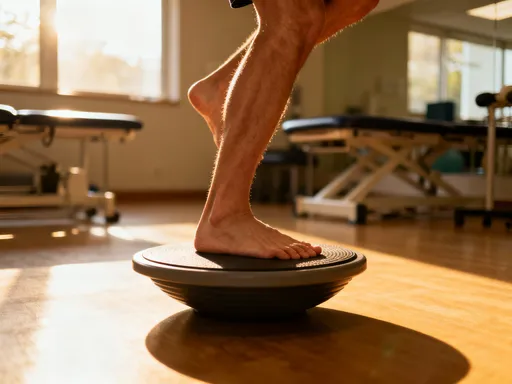
For those ready for added challenge, a wobble board or foam pad can be used. Stand on the unstable surface with both feet and attempt to keep the board level. As control improves, progress to single-leg stance on the device. These tools amplify sensory feedback, accelerating neuromuscular adaptation. Always use a wall or counter for safety during these exercises.
Finally, the step-up and hold exercise combines strength and balance. Step onto a low, stable platform (like a stair or aerobic step) with one foot, then bring the other foot up to meet it. Instead of stepping down immediately, hold the top position for 10 to 15 seconds, maintaining steady posture. This integrates balance with functional movement, mimicking real-life activities like climbing stairs. Perform five to eight repetitions per leg, focusing on control rather than speed.
Common Mistakes and How to Avoid Them
Despite its benefits, balance training can be ineffective—or even counterproductive—if approached incorrectly. One of the most common mistakes is rushing progression. Many people, eager to see results, attempt advanced exercises before mastering the basics. Trying to stand on a wobble board with eyes closed before being able to hold a single-leg stand for 30 seconds increases the risk of falls and discouragement. Progression should be gradual, based on consistent performance rather than ambition. A better approach is to master each stage before moving on, ensuring that the nervous system has time to adapt and integrate new movement patterns.
Another frequent error is ignoring pain or discomfort. While some muscle fatigue is expected, sharp pain, joint instability, or dizziness should never be pushed through. These signals indicate that the body is not ready for the current level of challenge. It’s essential to distinguish between effort and harm. If an exercise causes pain, reduce the difficulty, shorten the duration, or return to a previous step. Listening to the body’s feedback is not a sign of weakness—it’s a sign of intelligent training.
Some individuals treat balance work as a secondary task, tacking it on at the end of a workout or skipping it when short on time. However, balance is not a peripheral skill; it is central to functional recovery. It should be treated with the same priority as strength or flexibility training. Scheduling dedicated time—even just 10 minutes a day—ensures consistency and allows for focused attention on form and control.
Additionally, many people underestimate the value of professional guidance, especially when dealing with complex injuries. While basic exercises are safe for most, conditions involving vertigo, neurological impairments, or severe joint instability require tailored supervision. A physical therapist can assess individual needs, correct technique, and design a personalized program that aligns with recovery goals. Self-directed efforts are valuable, but expert input can prevent setbacks and accelerate progress.
Beyond Recovery: Building Long-Term Resilience
Balanced training should not end when recovery is complete. In fact, its greatest value may lie in its role as a lifelong practice for maintaining physical resilience. Just as brushing your teeth prevents dental problems, regular balance exercises help prevent falls, reduce joint strain, and preserve mobility as you age. The benefits extend far beyond injury rehabilitation—they contribute to better posture, improved coordination, and greater efficiency in daily movement. Whether you’re gardening, carrying laundry, or playing with children, strong balance makes every action safer and more effortless.
Over time, consistent practice leads to what experts call “movement intelligence”—a heightened awareness of how your body moves through space. This awareness allows for quicker adjustments, smoother transitions, and reduced risk of accidents. Studies have shown that adults who engage in regular balance training experience fewer falls and maintain independence longer than those who do not. For women in the 30–55 age range, many of whom juggle work, family, and household responsibilities, this kind of functional fitness is invaluable. It supports energy, reduces physical strain, and enhances overall quality of life.
Perhaps most importantly, balance training fosters a deeper connection between mind and body. It encourages mindfulness, patience, and self-trust—qualities that extend beyond physical health. The journey of recovery is not simply about returning to how things were before. It is an opportunity to rebuild with greater awareness, strength, and intention. By embracing balance as a core component of wellness, you’re not just healing an injury—you’re investing in a more resilient, confident, and capable version of yourself. Stability is not just a physical state; it is a foundation for a life lived with confidence and grace.