Taste Oaxaca Like a Local: Secrets Only the Best Food Lovers Know
Oaxaca isn’t just a destination—it’s a flavor explosion waiting to happen. From smoky mole to handmade tortillas, the city’s food scene is rich, authentic, and deeply personal. I’ll show you how to move beyond tourist traps and truly taste what locals love. With smart, simple techniques, you can turn every meal into a memory. This is about more than eating—it’s about connecting, discovering, and savoring. For the thoughtful traveler, especially those who value tradition, warmth, and the quiet pride of a home-cooked meal, Oaxaca offers something rare: food with soul.
Why Oaxaca Is a Food Lover’s Dream
Oaxaca stands as one of Mexico’s most revered culinary capitals, where every bite carries generations of history. The region’s cuisine is not simply about sustenance; it is a living expression of culture, shaped by Zapotec and Mixtec traditions and refined over centuries. Unlike more homogenized food scenes found in heavily touristed areas, Oaxaca’s gastronomy remains rooted in family kitchens, communal cooking, and seasonal rhythms. Here, meals are prepared with intention, often using ingredients grown in nearby valleys or foraged from the surrounding hills.
At the heart of Oaxacan cooking is **mole**, a complex sauce that embodies the region’s layered flavors. There are said to be seven classic moles—mole negro, coloradito, amarillo, verde, chichilo, manchamanteles, and rojo—each with its own blend of chiles, spices, nuts, seeds, and sometimes even chocolate. Mole negro, the most famous, can include over 20 ingredients, slow-roasted and ground on a metate for hours. The result is a deep, velvety sauce that balances heat, sweetness, earthiness, and smoke in perfect harmony.
Equally iconic is the **tlayuda**, often called the “Oaxacan pizza.” This large, crisp tortilla is spread with asiento (unrefined pork lard), black beans, quesillo (a soft, stringy cheese native to the region), and topped with shredded lettuce, avocado, and your choice of grilled meat or salsa. It’s a street food staple, best enjoyed late at night from a glowing roadside stall where families gather after dinner.
Another hallmark of Oaxacan food culture is its **artisanal chocolate**. Made from roasted cacao beans, ground with sugar and cinnamon, this chocolate is traditionally whisked into hot milk using a wooden molinillo to create a frothy, aromatic drink. Unlike mass-produced versions, Oaxacan chocolate retains a slightly gritty texture and bold, bittersweet flavor that reflects its authenticity.
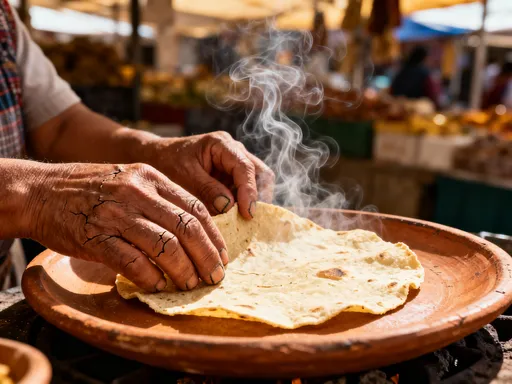
What truly sets Oaxaca apart is its commitment to **process and provenance**. Corn is nixtamalized in small batches, tortillas are pressed by hand, and salsas are roasted over open flames. These practices are not performative—they are everyday rituals passed down through generations. For the discerning traveler, particularly women who appreciate craftsmanship and care in meal preparation, Oaxaca offers a deeply resonant experience. It’s food made with patience, pride, and purpose.
How to Find Authentic Food Spots (Not Just Tourist Traps)
One of the greatest joys of traveling through Oaxaca is discovering where locals eat—those unassuming spots that don’t appear on guidebooks but are packed with regulars every day. While markets like El Mercado 20 de Noviembre are famous and worth visiting, the most memorable meals often come from quieter corners of the city. The key to finding them lies not in apps or reviews, but in observation and timing.
Start by **watching where locals line up**. If you see a small crowd of working people gathered around a cart at 7 a.m., especially with steam rising from large pots, that’s a strong signal of quality. Morning is when many vendors prepare their freshest batches of tamales, atoles, or tlayudas. These early hours are ideal for tasting food at its peak, before ingredients dry out or flavors dull.
Another effective strategy is **learning a few key Spanish phrases**. A simple “¿Qué recomienda?” (What do you recommend?) or “¿Qué es tradicional aquí?” (What’s traditional here?) goes a long way. Vendors appreciate the effort, and you’re more likely to be offered something special—perhaps a sample of homemade chorizo or a spoonful of freshly made salsa macha. Even better, ask “¿Hace falta esperar?” (Do I need to wait?) to gauge popularity without commitment.
Pay attention to **menu descriptions**, but don’t rely on them entirely. Some of the best dishes won’t be listed in English or may appear under generic names like “special de la casa.” When in doubt, point to what someone else is eating. In Oaxacan markets, this is not considered rude—it’s practical, and often welcomed. Trust your senses: if a dish smells rich and toasty, with notes of roasted chile or wood smoke, it’s likely worth trying.
Avoid places that cater exclusively to tourists—those with laminated menus in multiple languages, loud music, or staff who aggressively invite you in. Authentic spots tend to be low-key: a folding table, a few stools, and a cook who’s too busy to make eye contact. These are the places where tradition lives, where recipes are guarded like family heirlooms, and where every plate feels like an invitation.
Mastering the Art of the Food Market Walkthrough
Markets are the beating heart of Oaxacan food culture, and two stand above the rest: Mercado Benito Juárez and Mercado San Juan. These are not shopping centers—they are immersive sensory experiences. The air hums with sizzling griddles, the scent of toasted chiles, and the earthy aroma of fresh masa. Vendors call out specials, baskets overflow with seasonal produce, and colorful piles of dried chiles glow like jewels under the morning light.
Walking through these markets can feel overwhelming at first. To navigate them like a local, **go early**—ideally between 8 and 10 a.m., when the stalls are fully stocked and the heat hasn’t yet built. Bring small bills, as most vendors don’t carry change for large notes. Wear comfortable shoes and a light bag; you’ll want your hands free to sample and point.
Begin by **scanning for visual cues**. Look for masa that’s being freshly pressed into tortillas—this means it’s made that morning and will taste clean and slightly sweet. Avoid stalls where masa sits under plastic for hours. Similarly, quesillo should be soft, milky white, and coiled neatly in brine. If it’s dry or yellowed, it’s likely old.
When approaching a vendor, **make eye contact and smile**. A simple “buenos días” sets a friendly tone. If you’re unsure what to order, ask “¿Qué es lo más rico?” (What’s the tastiest thing?). Most will happily point to their specialty. Don’t feel pressured to buy large quantities—many vendors offer small portions for tasting. A single tamal, a half-tlayuda, or a cup of atole can be enough to assess quality.
One of the best ways to learn is to **follow the flow**. Notice where locals linger, which stalls have the shortest lines but the busiest kitchens, and where food disappears quickly. If a woman in an apron is constantly refilling a basket of empanadas de huitlacoche, that’s a sign they sell out fast—and for good reason. Come back later, and they might be gone.
And don’t skip the **non-food sections**. Baskets of chapulines (toasted grasshoppers), sold in clear bags with lime and chili, may seem daring, but they’re a protein-rich snack with a satisfying crunch. They’re also a sustainable food source with deep indigenous roots. Try a small handful—you might be surprised by the savory, umami flavor.
Decoding Oaxaca’s Signature Dishes—And Where to Try Them Best
To truly appreciate Oaxacan cuisine, it helps to understand its signature dishes—not just what they are, but why they matter. Each one tells a story of place, season, and tradition.
Take **mole negro**, for example. This legendary sauce originates from the convents of colonial Oaxaca, where nuns combined indigenous ingredients with Spanish techniques. The best versions are made with pasilla oaxaqueña, chilhuacle negro, and mulato chiles, toasted until fragrant, then blended with plantains, almonds, raisins, cloves, and Mexican chocolate. It’s traditionally served over chicken and accompanied by white rice. A high-quality mole should be complex but balanced—deeply savory with a hint of sweetness, not cloying or overly sweet like some tourist versions.
For an authentic taste, seek out family-run fondas or mid-sized restaurants like **Casa Oaxaca Comedor** or **Itanoni**, where the mole is made in-house and simmered for hours. Avoid places that serve mole in large, reheated batches—it loses its nuance.
**Tamales oaxaqueños** are another must-try. Unlike their corn-husk-wrapped counterparts elsewhere in Mexico, Oaxacan tamales are large, wrapped in banana leaves, and come in a variety of fillings: mole, red beans, chicken in green salsa, or even pineapple. They’re steamed slowly, which infuses them with a subtle banana leaf aroma. The masa should be moist and tender, not dry or crumbly.
Look for tamal vendors near churches on weekends or early in the morning. Many families buy them for breakfast after Mass. A simple tamal with black beans and cheese, eaten standing up with a cup of hot chocolate, is one of Oaxaca’s quietest pleasures.
**Memelas** are small, thick tortillas topped with beans, cheese, and salsa. They’re humble but satisfying, often eaten as a midday snack. The best ones are made with fresh masa and cooked on a comal until slightly blistered. Toppings should be generous but not overwhelming. Try them at a street stall in the Jalatlaco neighborhood, where they’re served with a side of pickled onions.
And then there are **chapulines**—toasted grasshoppers seasoned with garlic, lime, and chili. They’re crunchy, salty, and surprisingly addictive. While they may seem exotic, they’ve been eaten in Oaxaca for centuries and are still harvested sustainably from local fields. Buy them from a reputable vendor in the market, where they’re stored in clean containers and not exposed to dust or flies.
Understanding these dishes enriches the experience. It shifts eating from consumption to connection. When you know the history behind a tamal or the labor behind a mole, each bite becomes a tribute to Oaxaca’s culinary legacy.
Timing Your Meals for Maximum Flavor and Local Vibe
In Oaxaca, timing is just as important as taste. The city follows a natural food rhythm, shaped by work, weather, and tradition. Eating at the right time doesn’t just mean fresher food—it means joining the local flow.
Breakfast, for instance, begins early. Between 6 and 8 a.m., tamal vendors set up near bus stops, markets, and churches. This is when tamales are steamed fresh and still warm from the pot. A cup of **atole**, a thick corn-based drink flavored with vanilla, chocolate, or fruit, pairs perfectly. Look for women selling from large insulated containers—many have been doing this for decades.
Lunch, served between 2 and 4 p.m., is the main meal of the day. This is when fondas and family restaurants serve their full menus, including moles, tlayudas, and complex stews. Arrive early to avoid crowds, and don’t rush—meals here are meant to be lingered over. Many locals return home from work to eat with family, so this is also a time of connection.
Dinner in Oaxaca is often lighter and later. Night markets, like the one on Calle Mina, come alive after 7 p.m., offering tlayudas, quesadillas, and grilled meats. The atmosphere is lively, with music, laughter, and the sizzle of meat on the grill. This is a great time to try street food and observe daily life.
Weekends bring special treats. **Mole** is often reserved for Saturdays and Sundays, when families gather for long meals. Some markets host regional food fairs, where vendors from nearby villages sell specialties like tamales de mole or tasajo (thinly sliced grilled beef). These events offer a broader taste of Oaxaca’s diversity.
Seasonality also plays a role. During **Guelaguetza** (a cultural festival in July), food stalls overflow with regional dishes. In December, you’ll find **poles de yuca** and **buñuelos**, sweet fried dough dusted with cinnamon sugar. Eating seasonally connects you to the land and its cycles.
To avoid food fatigue, **pace yourself**. Try a few bites at each stop, share dishes with companions, and take breaks between meals. Hydrate with natural juices—hibiscus, tamarind, or mango—sold in plastic bags with straws. This way, you can enjoy multiple tastings without feeling overwhelmed.
Simple Etiquette Moves That Earn You Local Respect
Eating like a local isn’t just about what you eat—it’s about how you behave. Small gestures of respect can open doors, deepen connections, and even earn you an unexpected taste of something special.
First, **use cash whenever possible**. Many small vendors don’t accept cards, and paying in coins or bills directly supports their livelihood. Keep a small pouch with 20s and 50s (Mexican pesos) for easy access. When handing over money, place it in the vendor’s hand or in a tray—don’t toss it.
**Wait your turn**. Lines in Oaxaca are often informal, but they’re still observed. Stand behind others, make eye contact, and nod to acknowledge your place. Rushing or pushing is seen as disrespectful. Patience is valued, and those who wait quietly are often served with extra care.
When sampling, **start small**. Ask for “una probadita” (a little taste) before committing to a full portion. This shows you’re curious, not entitled. If you like it, buy it. If not, thank the vendor and move on. Never waste food—Oaxacans take pride in their cooking, and leaving uneaten portions can be seen as an insult.
**Pointing is acceptable** in markets. In fact, it’s often the most efficient way to order. Just smile and point to what you want. If you’re unsure about spice levels, ask “¿Es muy picante?” (Is it very spicy?) and start mild. You can always add more chili, but you can’t take it away.
Finally, **show appreciation**. A simple “delicioso” or “muchas gracias” means a lot. Some vendors may offer a bonus—a free tamal for a child, an extra spoon of salsa. Accept it with gratitude. These small exchanges are part of Oaxaca’s food culture: generous, communal, and deeply human.
Building Your Own Oaxacan Food Journey—Beyond the Checklist
The most meaningful food experiences in Oaxaca aren’t about ticking off dishes—they’re about slowing down, paying attention, and letting the city reveal itself one meal at a time. The goal isn’t to eat everything, but to eat with intention.
Consider **keeping a food journal**. Jot down what you ate, where, and how it made you feel. Note the name of a vendor, the smell of a market, the warmth of a fonda owner’s smile. These details become memories far more lasting than any photo.
**Revisit favorites**. If a certain tlayuda stand or tamal vendor stands out, go back. Familiarity builds trust. The cook may start to recognize you, offer recommendations, or even save a portion. This is how connections form—not through grand gestures, but through repeated, quiet moments.
Let curiosity guide you. If you see a dish you don’t recognize, ask about it. If a grandmother is selling something from a pot at her home, accept the invitation to try. Some of the best meals in Oaxaca happen off the map, in places without signs or addresses.
And when you return home, **bring the experience with you**. Try making a simple version of mole or tlayuda. Buy Oaxacan chocolate and whisk it into hot milk. Share stories with family and friends. Cooking becomes a way to honor what you learned.
True food travel is not about quantity. It’s about depth. It’s the joy of tasting something real, made with care, shared with kindness. In Oaxaca, every meal is an invitation—to slow down, to connect, to belong, even if just for a moment.