You’ve Never Seen Iceland Like This – Vik’s Secret Winter Festival Magic
Most travelers flock to Iceland for waterfalls and northern lights, but few know about the quiet charm of Vik in winter. I stumbled upon a local celebration that changed my entire view of this icy island. It wasn’t on any tourist map—just drumbeats echoing through snow-covered hills, laughter in frosty air, and traditions passed down for generations. This is not just a trip; it’s a rare window into Iceland’s soul. Let me take you where guidebooks don’t.
Discovering Vik Off the Beaten Path
Vik í Mýrdal stands as one of Iceland’s most remote coastal villages, tucked along the southern shore where the North Atlantic meets dramatic cliffs and volcanic plains. With a population of fewer than 400, this tiny settlement is often bypassed by tour buses en route to more famous attractions like Skógafoss or Jökulsárlón. Yet it is precisely this isolation that has allowed Vik to retain a sense of authenticity rarely found in destinations shaped by mass tourism. In winter, when the summer throngs have vanished and snow blankets the hills, Vik reveals a different rhythm—one measured not by sightseeing checklists but by candlelight and conversation.
The landscape surrounding Vik is nothing short of cinematic. Reynisfjara Beach, with its black basalt columns and roaring surf, feels like the edge of the world. The sea stacks of Reynisdrangar rise like ancient sentinels from the waves, steeped in folklore as petrified trolls caught in daylight. Behind the village, snow-dusted mountains frame the horizon, while fog often rolls in from the ocean, softening the contours of the land. This raw, untamed beauty mirrors the spirit of the people who call Vik home—resilient, self-reliant, and deeply connected to their environment.
Unlike the bustling summer months, when international visitors fill rental cars and crowd photo spots, winter in Vik is marked by stillness. Roads are quieter, shops operate on reduced hours, and life slows to a contemplative pace. This seasonal shift creates space for intimate community gatherings—events born not for tourism but for tradition. One such event, largely unknown outside Iceland, is the village’s annual winter festival, a gathering rooted in centuries-old customs of warmth, storytelling, and shared endurance.
The Heart of Winter: A Local Festival Like No Other
Every year, in the coldest stretch of January or early February, Vik comes alive with a quiet kind of magic. The winter festival, known locally as Vetrarhátíð í Vík, is not advertised on glossy travel websites or included in standard tour packages. It exists because the community chooses to keep it alive—not as a performance for outsiders, but as a reaffirmation of who they are. The festival unfolds over three days, centered around the local community center, a modest wooden building warmed by stoves and human presence.
Evenings begin with storytelling, a tradition deeply embedded in Icelandic culture. Elders take turns recounting folk tales—tales of hidden people, mountain spirits, and ancestors who braved storms in open boats. These are not theatrical performances but heartfelt recitations, often delivered in soft voices that demand attentive silence. Children sit cross-legged on the floor, wrapped in woolen blankets, while visitors are welcomed to pull up wooden chairs and listen. The stories do not end with moral lessons but linger like smoke, inviting reflection on nature’s power and human fragility.
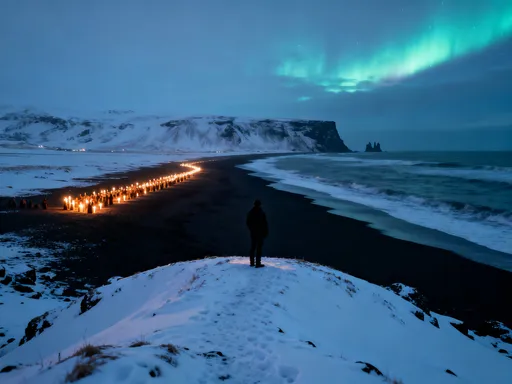
One of the most moving moments is the candlelit procession along Reynisfjara Beach. As darkness falls early, around 4:30 in the afternoon, villagers gather at the edge of the black sand, each holding a small lantern. They walk slowly toward the sea, their lights flickering against the wind, forming a glowing ribbon against the monochrome shoreline. No speeches are made. No music plays. Just the sound of waves, footsteps on wet sand, and the occasional murmur of prayer or song. It is a moment of collective stillness, a silent tribute to those who came before and those who will follow.
Music, too, plays a central role. Local musicians perform on traditional instruments like the langspil, a simple stringed instrument with a haunting, droning tone, and the fiðla, an Icelandic variant of the fiddle. Songs are sung in Icelandic, many of them centuries old, their lyrics speaking of love, loss, and the changing seasons. Visitors are sometimes invited to join in simple harmonies, not because they know the words, but because the act of singing together matters more than perfection. This is not entertainment; it is participation in a living cultural heartbeat.
Why This Festival Matters: Culture Beyond the Surface
To understand the significance of Vik’s winter festival, one must first understand the Icelandic relationship with winter. For much of the year, especially in coastal villages like this, daylight is scarce. From November to January, the sun barely crests the horizon, leaving weeks of twilight and long, dark nights. Historically, these conditions were not just inconvenient—they were survival challenges. Isolation, cold, and limited resources required more than physical endurance; they demanded emotional resilience and strong community bonds.
Winter festivals like the one in Vik emerged as essential tools for psychological and social survival. They provided structure, purpose, and joy during the most difficult months. By gathering to share stories, songs, and warmth, people reminded themselves that they were not alone. These traditions were not distractions from hardship but ways of transforming it into something meaningful. In a world increasingly driven by speed and convenience, such practices offer a powerful counter-narrative—one that values presence over productivity, connection over consumption.
Today, even with modern heating, electricity, and internet access, rural Icelanders continue to honor these customs. Language preservation is a quiet but urgent mission. With fewer than 400,000 native speakers worldwide, the Icelandic language is vulnerable to erosion, especially among younger generations exposed to global media. Storytelling events like those at the festival serve as living classrooms, where dialects, idioms, and poetic forms are passed down orally. Similarly, traditional music is not performed as nostalgia but as an active expression of identity.
For travelers, participating in such a festival is not about ticking off a cultural box. It is about stepping into a worldview where community is sacred, where darkness is not feared but embraced as a time for introspection, and where hospitality is not transactional but heartfelt. Unlike guided tours that explain culture from a distance, this experience immerses visitors in its rhythm. You are not observing tradition—you are, for a brief moment, part of it.
How to Experience It: Timing, Access, and Etiquette
For those seeking to attend Vik’s winter festival, timing is essential. The event typically takes place in late January or early February, dates varying slightly each year based on community availability and weather conditions. There is no official website or ticketing system; information is shared through local networks, regional news bulletins, and word of mouth. Travelers are encouraged to contact the Vik Tourist Information Center in advance or check with accommodations in the area for updates.
Reaching Vik requires planning, especially in winter. Located approximately 180 kilometers (about 112 miles) southeast of Reykjavík, the village is accessible via Route 1, Iceland’s famous Ring Road. The drive takes roughly 2.5 hours under favorable conditions, but winter weather can bring snowstorms, high winds, and reduced visibility. It is strongly advised to rent a four-wheel-drive vehicle equipped for icy roads and to monitor road.is, the official Icelandic road conditions website, before departure. Public transportation options are limited, with only a few daily bus services operating between Reykjavík and Vik, making a private car the most reliable and flexible choice.
Accommodation in Vik ranges from small guesthouses to family-run farms offering cozy rooms with home-cooked breakfasts. Staying in a locally owned property enhances the experience, as hosts often share personal insights about the festival and may even invite guests to join informal gatherings. Booking well in advance is recommended, as rooms fill quickly during the festival period.
When attending the festival, visitors should approach with respect and humility. This is not a performance for tourists but a community event. Always ask before taking photographs, especially during storytelling or candlelit moments. Dress warmly, not just for the outdoors but for indoor spaces, which may be heated but not overly warm. Participate when invited, but do not expect constant entertainment—many moments are quiet, reflective, and deeply personal. Above all, embrace the pace. Conversations may unfold slowly. Events may start later than scheduled. These are not inefficiencies but expressions of a culture that values presence over punctuality.
Beyond the Festival: Hidden Winter Gems in Vik
While the festival is the heart of the winter experience, Vik offers other quiet wonders for those willing to explore at a gentle pace. One of the most profound experiences is walking Reynisfjara Beach at dawn. In winter, the beach is often empty, the only sounds the crash of waves and the wind moving through basalt columns. The black sand, glistening with frost, stretches toward the sea, where the Reynisdrangar towers stand like ancient guardians. Fog may obscure the horizon, creating a dreamlike atmosphere that feels suspended outside of time.
Nearby, the Fjaðrárgljúfur Canyon offers a striking contrast. Just a short drive from Vik, this serpentine gorge, carved by glacial rivers over millennia, is draped in ice and snow during winter. Wooden walkways allow safe access to viewpoints, where the frozen waterfalls and layered rock walls create a landscape of quiet grandeur. Because it is less accessible in winter, few visitors make the journey, making it a rare place of solitude and natural beauty.
For a moment of warmth, locals recommend stopping by a small café in the center of Vik, often run by a family for generations. Here, you might find traditional dishes like kjötsúpa, a hearty lamb stew simmered with root vegetables, served with rye bread and butter. The menu is simple, the seating limited, but the atmosphere is welcoming. It is not uncommon for strangers to strike up conversations over coffee, sharing stories of travel, weather, or family.
Birdwatchers will also find quiet joy in Vik’s winter landscape. While puffins depart for the open sea in autumn, other seabirds remain—fulmars, guillemots, and gulls that ride the coastal winds. From the cliffs above Reynisfjara, one can spend hours watching their flight patterns, a reminder that life persists even in the harshest conditions. These moments of stillness, far from crowds and schedules, offer a different kind of enrichment—one measured not in photos taken but in peace received.
Traveler’s Mindset: Embracing the Unexpected
Traveling to Vik in winter requires a shift in mindset. This is not a destination for those seeking comfort, predictability, or Instagram-perfect moments. Storms may delay plans. Roads may close. Events may be rescheduled. But within these uncertainties lies the essence of authentic travel—the opportunity to let go of control and open oneself to what is real, unfiltered, and unplanned.
I recall one evening when a sudden snowstorm forced the cancellation of an outdoor concert. Instead, the musicians gathered in a small living room of a guesthouse, where twenty of us sat on floors and sofas, sipping hot chocolate as they played folk songs by candlelight. There was no stage, no microphone, no audience—only music, warmth, and shared silence between verses. An elder in the corner began reciting a poem about winter’s beauty, and though I did not understand all the words, the tone carried meaning: gratitude for light in darkness, for company in solitude.
Another morning, I joined a local family on a walk to a frozen stream behind their farm. We said little, but the act of walking together—boots crunching on ice, breath visible in the air—felt deeply connective. At one point, the youngest child pointed to a track in the snow and whispered, ‘Reindeer.’ We followed the trail in silence until it disappeared into the trees. We never saw the animal, but the possibility was enough. These were not grand adventures, but they were real. They stayed with me long after I returned home.
To travel this way is to redefine what matters. It is not about how many places you see, but how deeply you feel. It is not about capturing moments, but about being present within them. In Vik, I learned that the most meaningful journeys are not those that take us far from home, but those that bring us closer to what is true: community, resilience, and the quiet beauty of simply being together.
Conclusion: A Different Kind of Icelandic Adventure
Vik’s winter festival is not a spectacle. It does not dazzle with lights or attract crowds. It does not promise excitement or adrenaline. Instead, it offers something rarer: authenticity. It invites travelers to step away from the well-trodden path and into the quiet heart of Icelandic life—a place where tradition is lived, not displayed, and where warmth is measured not in degrees but in human connection.
This festival is a testament to the enduring power of community, especially in the face of isolation and darkness. It reminds us that culture is not something to be consumed but experienced—through stories told in soft voices, songs played on old instruments, and walks taken in silence. It challenges the modern travel ethos of constant movement and endless novelty, offering instead a slower, deeper way of seeing.
For women between 30 and 55—many of whom balance family, work, and personal dreams—this kind of journey can be especially meaningful. It is not an escape, but a reconnection. It speaks to the quiet strength within, the desire for purpose, and the longing to belong. In Vik, one finds not just a destination, but a reflection of values that endure: care, continuity, and courage.
So if you are ready to see Iceland beyond the postcard, to feel its soul rather than just photograph its surface, consider a winter journey to Vik. Let the cold sharpen your senses. Let the darkness deepen your vision. And let the people, the stories, and the silence remind you that the most profound adventures are often the quietest ones. This is not just travel. This is transformation.